
How to structure your pole dance routine: it starts from the minute you walk toward the stage!
Your pole dance routine could be a carefully choreographed piece, or it could be a freestyle. Regardless of which style works best for you, here are some overall structural components to consider. These components are applicable to either a judged competition or a showcase.
Your routine starts the minute you walk toward the stage.
Sometimes “stage” is a generous term. It might be an actual lifted stage with a set of stairs leading up to it, or it might be a patch of ground in front of a stage pole, or even just a few poles in your regular studio that now have an audience aimed at them. In any case, how you walk onto the “stage” is important!
Your walk on could be part of your story or your character or it might just be you! The important thing for your walk on is that it is intentional. Try not to look nervous – this is where having a character that you can portray can help – and walk with confidence (or whatever emotion is appropriate for your piece) to your starting position.
Create a visually stunning routine with multiple levels.
Once your music starts (or perhaps it started during your walk on) this is the bulk of your performance. You want to create a routine that has multiple “levels.” This is a dance term that means you visually want to move your body from low to high and potentially back again. In a pole context, this means showing that you can do floorwork, dance while standing, execute pole moves from a standing position, and if relevant to your level/category/intention, execute pole moves in the air.
You can ascend and descend as many times and changes levels as much as is relevant to create a visually stunning routine. What tricks, movements, and/or props you use during the routine is up to you! (Check out this blog for some ideas on how to build the “meat” of your routine.)
Movement with intention between poles.
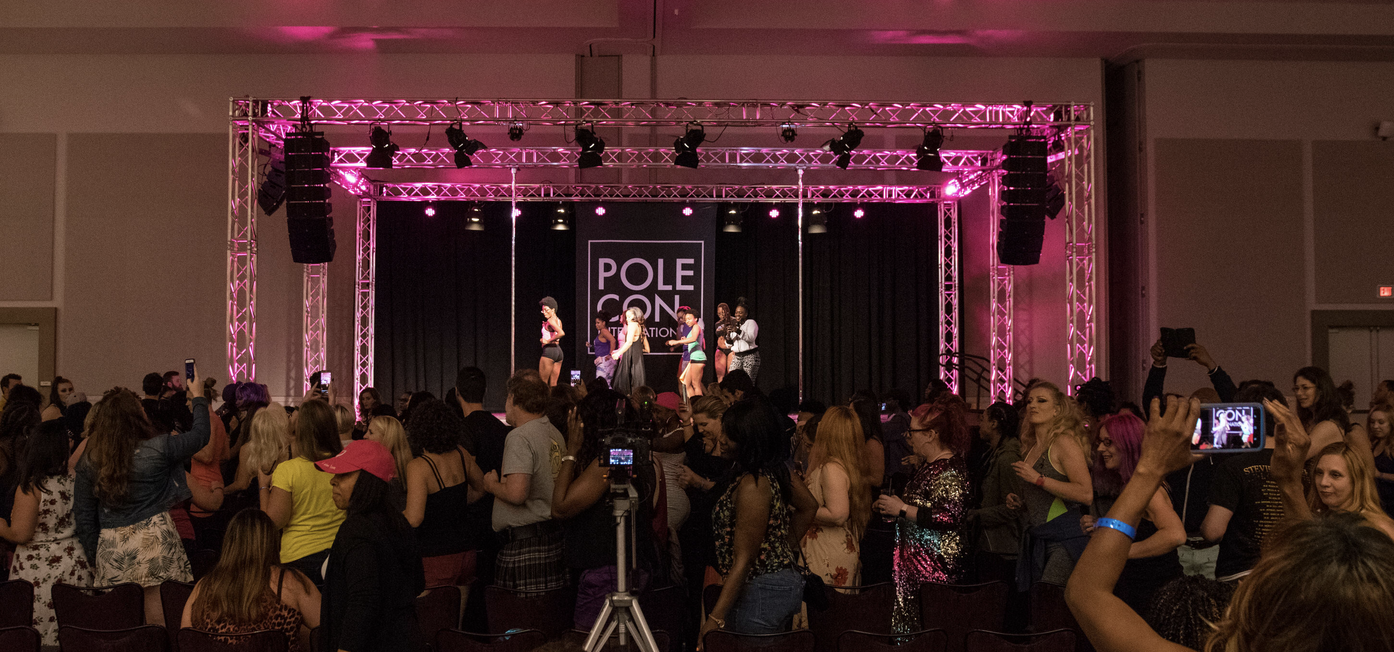
In many competitions, you will have access to two poles on a truss system, which looks like a metal box. Typically, one pole is set to static, and one is set to spin consistently for all performers. In a showcase there might be a wide variety of set ups including one or multiple poles, stage poles rather than stationary poles, and/or the ability to change the spin/static of any pole(s). If you can move between multiple poles—use that space and find a way to dance between poles. This could be a standing dance or floorwork. It could even be a character walk.
But please, do not *just* walk between poles.
Ending your routine.
While there is no official “best” way end a routine, you want it to be obvious that you are done.
Some performers or competitors choose to hold a pose as the music ends while others might walk off stage. Whatever you are doing, make it clear and intentional, particularly if your music is not cut to the exact length you intend to perform. If this is the case, talk to the sound technician/DJ beforehand and let them know to fade out your music when you walk off in case the song isn’t over.
After you have finished your routine, acknowledge your audience. How you do this might vary depending on the situation (competition vs. showcase). You don’t have to bow but you could. You could also blow kisses, wave, smile, or do something else that is appropriate for the emotion or character of your piece. This is also a great time to enjoy the applause! You earned it!
Exiting the stage.
Like coming on stage with intention, you want to exit the same way. Avoid the temptation to run off stage or break character. If you performed a strong piece, end strong.
The piece doesn’t officially stop until you are off the stage. Then you can laugh, cry, scream, melt into a puddle or whatever other emotion you are feeling in the moment.
Creating a pole dance routine isn’t just about the movements, it’s about the entire mystique of being up on stage with an audience. Consider these tips the next time you create a routine to make sure ALL the parts of your routine from the minute you walk on stage showcase you and your concept in the best possible way.

- Updates to PoleCon 2027 - October 12, 2026
- PoleCon: West 2026 Updates from the Survey - October 9, 2026
- What responsibility does the audience have? - October 2, 2026
Related Posts